
7 Best AI Worksheet Generators for Students in 2026
A
Ashutosh Gupta
Share:

Advertisement
There's no shortage of AI worksheet tools. The problem is that almost all of them were built for teachers. Search for "AI worksheet generator" right now and every top result is pitched at educators creating classroom materials — not students who need a practice set at 11pm the night before an exam.
In 2025, HEPI and Kortext surveyed 1,041 full-time undergraduates and found 92% now use generative AI for academic work, up from 66% the year before (Higher Education Policy Institute, Student Generative AI Survey 2025). The dominant use case isn't writing essays. It's studying. And 51% of those students said saving time was the primary reason they reached for AI tools, while 50% cited improving the quality of their work.
Advertisement
We evaluated more than 15 tools against five criteria: student-first design, free tier depth, subject breadth, question type variety, and actual output quality. These 7 made the cut.
For a broader look at every AI study tool category, see our guide to the best AI tools for students in 2026.
TL;DR — Key Takeaways
- In 2025, 92% of university students used generative AI for academic work, up from 66% in 2024 (HEPI/Kortext, 2025).
- Retrieval practice (quizzes and worksheets) yields 67% accuracy after one week vs 48.6% for re-reading alone — an 18-point gap (Frontiers in Psychology, 2025).
- Most AI worksheet tools are teacher-facing; the tools below are chosen specifically for student self-directed study.
- Geleza and NoteGPT offer the most accessible free tiers; Khanmigo and Quizgecko lead on learning depth.
Why Practice Worksheets Beat Passive Re-reading
In 2025, a peer-reviewed randomized study in Frontiers in Psychology tracked 27 fifth-grade students across retrieval practice and passive re-reading conditions — and students who completed practice tests hit 67% mean accuracy after one week, against 48.6% for students who re-read the same material (p < 0.001) (Frontiers in Psychology, "Retrieval Practice in Primary School Settings," 2025). That's not a marginal difference. It's the gap between a B and a C.
The mechanism is straightforward. Rereading your notes feels productive because it's easy — your brain recognizes familiar material and signals comprehension. But recognition isn't the same as retrieval. When you close the book and try to answer a question from memory, your brain works to reconstruct the information. That effort strengthens the memory trace in ways that passive exposure doesn't.
What AI changes here is the friction. Before, generating a practice worksheet from your own notes took 20–30 minutes of manual work. With an AI worksheet generator, you paste a chunk of your lecture notes, hit generate, and answer questions calibrated exactly to what you studied — not to a generic question bank.
Our finding: Students who generate practice questions from their own notes — rather than relying on pre-built question banks — consistently report better alignment between practice and what actually appears on their exams. Generic banks test generic facts; note-based AI worksheets test what you actually studied. That specificity gap is why note-based generation outperforms pre-built flashcard libraries for exam prep.
How We Selected These 7 Tools
We started with 15+ AI worksheet and quiz generators identified from educator forums, student Reddit communities, and App Store rankings. Each was evaluated against five criteria:
- Can a student use it solo? — does the interface serve a solo learner, or does it require a teacher account to unlock anything useful?
- What's free, really? — can a student get meaningful value without paying?
- Subject breadth — does it handle your actual subject, not just math or spelling?
- Question type variety — multiple choice, short answer, fill-in-the-blank; variety prevents pattern-recognition shortcuts
- Does it test understanding? — do generated questions require active recall, or just surface recognition of pre-loaded facts?
No tool on this list paid for placement. Pricing is verified as of May 2026.
1. Geleza — Best for All-in-One Student Study Loop
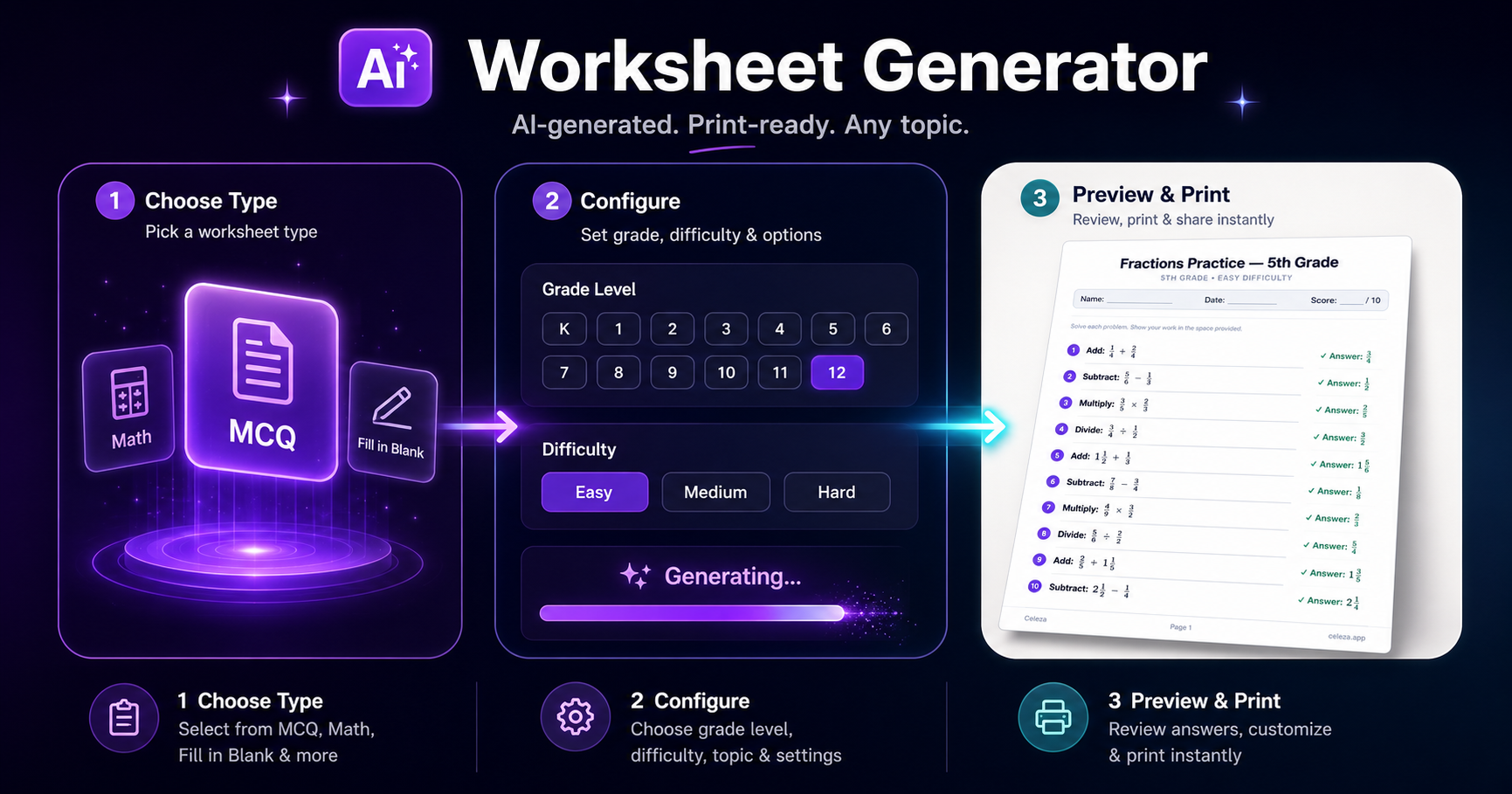
Geleza is built for students, not teachers. Enter any topic or paste a chunk of your lecture notes, pick 5–20 questions, and it returns a complete multiple-choice worksheet — four options, correct answer marked, and a plain-English explanation for every question — in under 10 seconds.
Why it stands out: Most worksheet tools make you choose between generating materials and actually studying. Geleza puts quiz generation inside a full study dashboard: AI Chat, PDF Chat, Math Solver, Writing Tools, and a YouTube Summarizer all live alongside the quiz generator. You can upload a lecture PDF, generate a worksheet from it, immediately ask the AI Chat to clarify anything you got wrong, and rerun the quiz — without leaving the app.
Best for: Students who want one app to cover their entire study session, from material review through self-assessment.
Key feature: Topic flexibility is unusually broad. "French Revolution causes," "JavaScript closures," "mitochondrial function in plant cells" — all produce accurate, curriculum-relevant questions. It doesn't require textbook alignment or content from a pre-loaded library.
Geleza's explanation feature — showing you why the correct answer is correct, not just marking wrong answers red — is what turns it from a test tool into an actual learning tool. Most competing tools just score you; this one teaches you.
Pricing: Free tier includes 100 credits per month (no credit card required). Scholar plan: $5/month (500 credits). Leader plan: $10/month (1,500 credits).
Ready to try it? Generate your first worksheet with Geleza — free, no credit card.

2. Quizlet — Best for Spaced Repetition and Flashcards
In 2025, Quizlet's AI features gained the ability to turn any uploaded PDF, slide deck, or pasted notes into a complete flashcard set automatically, then manage your review schedule so cards reappear right before you'd forget them (Quizlet, AI Study Tools Feature Page, 2025). The Learn mode adapts based on what you get right and wrong; Test mode generates a quiz from your set automatically.
Why it stands out: Spaced repetition is one of the most evidence-backed study techniques available. In 2013, Dunlosky et al. rated spaced practice "high utility" in a landmark meta-analysis of 10 study techniques published in Psychological Science in the Public Interest — the top rating, with strong evidence across subject areas and student ages (Dunlosky et al., Psychological Science in the Public Interest, 2013). Quizlet automates the review schedule so you don't have to manage it yourself.
Ideal for: Students in memorization-heavy courses — anatomy, foreign language vocabulary, history dates, chemistry formulas, constitutional amendments — where reviewing material over multiple weeks beats a single session.
Key feature: Q-Chat AI tutor engages you with Socratic questions built from your own flashcard set. It's a closer approximation of a study partner than a quiz engine.
Pricing: Free tier available with limited AI access. Quizlet Plus: $35.99/year. The Test mode and full Learn mode require a paid plan — a real limitation for budget-conscious students.
3. StudyX — Best for Homework Help Plus Study Generation
As of 2025, StudyX handles two tasks that competing tools rarely combine: it solves your current homework problem step-by-step AND generates study materials from the same content in the same session (StudyX.ai, 2025). Snap a photo of a problem, upload a PDF, paste a YouTube link, or type a question — all inputs produce a step-by-step solution that can immediately generate AI flashcards and practice quizzes.
Why it stands out: The workflow is tighter than juggling two separate apps. You're not copying a math solution from one tool into another to build review cards. StudyX keeps the full loop inside one session, which matters when you're working across multiple assignments.
Works best for: Students who move frequently between "I need help with this problem right now" and "I need to study this concept for next week's exam."
Key feature: Multi-format input works on a phone. Photographing a textbook page and generating questions from it takes about 30 seconds — faster than typing the content out manually.
Pricing: Free tier: 5 questions/day. Paid plans start at $1.99/month for unlimited responses. The platform reports 16M+ users, with 92% reporting grade improvement — though these figures are vendor-stated and unverified independently.
4. Khanmigo — Best for Guided Socratic Learning
In 2025, Khanmigo's core design remained deliberately restrictive: it won't just hand you the answer. Khan Academy's AI tutor asks what you've already tried, what you think the next step might be, and which part doesn't make sense — then guides you toward the answer rather than giving it (Khanmigo for Learners, 2025).
Why it stands out: Students who've discovered they can game other AI tools by asking for direct answers run into a different experience with Khanmigo. It closes that loop by design, which forces the cognitive work that actually builds understanding.
Works best for: Middle and high school students in math, science, history, and writing who want to genuinely understand material rather than just pass a quiz on it. SAT prep is particularly strong.
Key feature: Full integration with Khan Academy's video and exercise library. Watch a video, get stuck, ask Khanmigo in the same interface, and work through the confusion — without switching tabs or apps.
Pricing: $4/month or $44/year for learners and parents. Free for teachers and U.S. public school students with a school account. U.S. billing address required.
5. Quizgecko — Best for Multiple Question Types
Where most tools default to multiple choice, Quizgecko generates four distinct question formats from the same source material: MCQ, true/false, fill-in-the-blank, and short answer (Quizgecko, 2025). That variety matters because different question types test different depths of understanding, and practicing across formats is closer to what most exams actually require.
Why it stands out: MCQ-only tools develop a recognition shortcut over time — you start identifying the right answer from context clues rather than actual recall. Adding fill-in-the-blank and short-answer questions forces active generation of the answer, which is cognitively harder and more effective for retention.
Best for: College students preparing for written exams, or anyone who studies from their own notes and readings across a broad subject.
Key feature: Spaced repetition for AI-generated flashcards with a statistics dashboard showing which sub-topics drove your errors — not just an overall score.
Pricing: Basic plan free with limits. Student plan: $16/month. Pricier than alternatives, but the question type breadth justifies it for serious exam prep.

6. NoteGPT — Best Free No-Sign-Up Option
In 2025, NoteGPT's worksheet generator remains the lowest-friction option on this list. No account. No credit card. Enter a subject and grade level, click generate, download a printable PDF (NoteGPT AI Worksheet Generator, 2025).
Why it stands out: Sometimes you need a quick fill-in-the-blank worksheet on photosynthesis before bed and don't want to sign up for a new platform. NoteGPT doesn't require one. There's no paywall on basic generation, and the PDF output is print-ready without additional formatting.
Right pick if: you need a fast, printable worksheet for a specific topic without committing to a new platform. Also useful as a backup tool even if you primarily use something else — the no-account PDF export fills a workflow gap.
Key feature: Bilingual support (English and Chinese), with subject coverage across math, spelling, phonics, science, and reading comprehension. The downloaded PDF is formatted for print as-is.
Advertisement
Worth knowing: NoteGPT works well as a complement to paid tools, not just a standalone alternative. When you want a quick printable practice page without opening your main study app, it's faster than any account-gated option — no login screen, no credit check, no waiting.
Pricing: Completely free. No plans, no tiers, no credit card.
7. Edulastic — Best for Standards-Aligned Test Prep
In 2025, Edulastic's question bank surpassed 38,000 items across math, ELA, science, and social studies — all tagged to state standards and Common Core — and the platform supports 50+ technology-enhanced question types including equation editors, number lines, drag-and-drop, and graphing tools (Edulastic/Pear Assessment, 2025). For students whose teachers assign Edulastic practice, the interface is already familiar. For self-directed use, the public question bank is accessible without a paid plan.
Why it stands out: For standardized test prep, a question bank aligned to the exact format and difficulty of what you'll face is more useful than a generate-from-notes tool. Edulastic's specificity to state assessments and AP formats is hard to replicate.
Ideal for: High school students in math and ELA preparing for state assessments, AP exams, or the SAT who want practice in the actual test format, not a general-purpose quiz.
Key feature: Auto-grading across all 50+ question types, including open-ended responses scored against rubrics — useful for writing practice without waiting for a teacher to mark it.
Pricing: Free for students (unlimited practice). Teacher Premium: $100/year for advanced reporting and parent communication features.
Quick Comparison: 7 Tools at a Glance
| Tool | Best For | Free Tier | No Sign-Up | Question Types | Subject Range |
|---|---|---|---|---|---|
| Geleza | All-in-one study loop | 100 credits/mo | No | MCQ + explanations | Any topic |
| Quizlet | Spaced repetition | Limited AI | No | Flashcards, tests | Any topic |
| StudyX | Homework + study | 5 q/day | No | MCQ, flashcards | 50+ subjects |
| Khanmigo | Guided Socratic | None (paid) | No | Guided Q&A | Khan library |
| Quizgecko | Varied question types | Yes (limited) | No | MCQ, T/F, FIB, short answer | Any topic |
| NoteGPT | Fast printable worksheet | Unlimited | Yes | Fill-in, open-ended | Math, language, science |
| Edulastic | Standards-aligned test prep | Yes (38K+ bank) | No | 50+ types | Math, ELA, science |
How to Get the Most From Any AI Worksheet Generator
Picking the right tool is maybe 20% of the equation. How you use it is the rest.
Generate from your own notes, not just a topic name. "Photosynthesis" produces a generic worksheet. Pasting your lecture notes on photosynthesis produces questions calibrated to exactly what your professor covered. The second version is far more useful for your specific exam.
Answer before checking. This sounds obvious, but the temptation to read the explanation before attempting a question is real. The cognitive effort of trying to retrieve an answer — even unsuccessfully — is most of what drives retention. Look it up after, not before.
Rerun the same worksheet 24 hours later. One practice session shows you what you don't know right now. A second session the next day shows what actually stuck — the Frontiers in Psychology retrieval study found that a spaced review session meaningfully elevated accuracy above same-session cramming (Frontiers in Psychology, 2025). Most tools on this list support regenerating or reusing sets. Few students actually do this step.
Vary your question types over a study cycle. Use MCQ for initial exposure to a topic, then shift to short-answer and fill-in-the-blank questions as your exam gets closer. The harder retrieval formats build more durable memory.
Want the full picture on what actually works? Our 5 study techniques backed by science covers the complete evidence base.
Frequently Asked Questions
What is the best free AI worksheet generator for students?
NoteGPT's AI Worksheet Generator requires no sign-up and is completely free, making it the easiest starting point if you want something immediately. For students who want a complete study loop — quiz generation, AI Chat, and PDF analysis in one place — Geleza's free tier includes 100 credits per month (about 50 practice quizzes) without a credit card. StudyX offers 5 free questions per day.
How are AI worksheet generators different from just asking ChatGPT?
ChatGPT gives you raw text that you'd have to format manually into a worksheet. AI worksheet generators produce structured, ready-to-use question sets — multiple choice with four options and an answer key, fill-in-the-blank with the blanks already placed, or true/false with explanations — in seconds. Tools like Quizgecko and Geleza also track your performance across sessions, something ChatGPT doesn't do at all.
Do AI worksheet generators help you learn, or just memorize?
It depends on the question type. Multiple choice and short-answer questions engage active retrieval — your brain has to reconstruct the answer, not just recognize it. In 2025, a peer-reviewed study in Frontiers in Psychology found retrieval practice yielded 67% mean accuracy after one week versus 48.6% for re-reading alone (Frontiers in Psychology, 2025). Flashcard-only tools can slide into passive recognition if you just flip through cards without covering the answer.
Can I use an AI worksheet generator for any subject?
Yes for most subjects. Geleza, Quizgecko, and StudyX handle any topic you type or paste — "French irregular verbs," "Byzantine Empire," "binary search trees," anything. Khanmigo is limited to Khan Academy's content library. Edulastic is strongest for standardized math, ELA, and science. NoteGPT focuses on math, spelling, phonics, and reading comprehension.
Are these tools safe for students to use independently?
Yes — all seven tools on this list are designed for student use and don't require parental accounts to access the core features. Khanmigo has explicit safety protocols for users under 18. For any AI-generated content, verify factual claims before treating an answer key as authoritative. AI makes arithmetic errors in multi-step problems and occasionally hallucinates specific dates or figures.
The Bottom Line
If you want a free all-in-one study tool that generates worksheets from any topic and keeps your whole study session in one place, Geleza is the straightforward starting point. NoteGPT is the right call if you need something printable right now without creating an account.
For long-term retention, Quizlet's spaced repetition and Khanmigo's Socratic method are worth the cost if your budget allows. If you're preparing for standardized tests, Edulastic's question bank is as close as you'll get to the actual test format without buying official prep materials.
The tool matters less than the habit: generate questions from what you're actually studying, answer them without peeking, and revisit them the next day. That sequence is what the research supports — and any of the tools above can run it.
If you're a teacher looking to create materials for your class, the companion guide how to create AI worksheets for teachers covers the full classroom workflow.
Start generating practice worksheets now with Geleza's AI worksheet generator — free, no credit card required.
Sources
- Higher Education Policy Institute (HEPI) / Kortext, "Student Generative AI Survey 2025," retrieved 2026-05-26, https://www.hepi.ac.uk/reports/student-generative-ai-survey-2025/
- Frontiers in Psychology, "Retrieval Practice in Primary School Settings," retrieved 2026-05-26, https://www.frontiersin.org/journals/psychology/articles/10.3389/fpsyg.2025.1632206/full
- Dunlosky, J. et al., "Improving Students' Learning With Effective Study Techniques," Psychological Science in the Public Interest, 2013, retrieved 2026-05-26, https://doi.org/10.1177/1529100612453266
- StudyX.ai, platform page, retrieved 2026-05-26, https://studyx.ai/
- Geleza, AI Quiz Generator, retrieved 2026-05-26, https://geleza.app/tools/quiz-generator
- NoteGPT AI Worksheet Generator, retrieved 2026-05-26, https://notegpt.io/ai-worksheet-generator
- Quizgecko, retrieved 2026-05-26, https://quizgecko.com/
- Khanmigo for Learners, retrieved 2026-05-26, https://www.khanmigo.ai/learners
- Quizlet AI Study Tools, retrieved 2026-05-26, https://quizlet.com/features/ai-study-tools
- Edulastic / Pear Assessment, retrieved 2026-05-26, https://edulastic.com/
Advertisement
Found this helpful?
Share it with your classmates.
Share: