

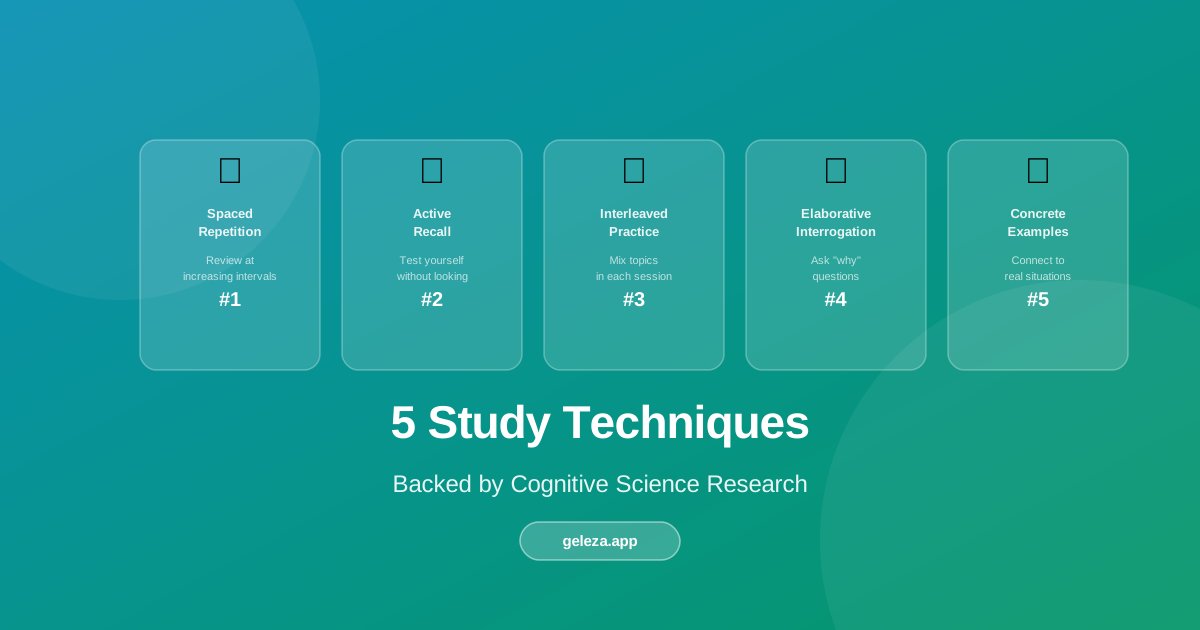
5 Study Techniques Actually Backed by Science
D
Dr. Sarah Chen
Learning Scientist
Share:
Advertisement
Every student has been told to "study harder." Almost no one is told how to study effectively. The gap between effort and results is almost always a strategy problem, not an effort problem.
Here are five techniques with the strongest scientific evidence behind them — and why most students default to the least effective methods instead.
Advertisement
Key Takeaways
- Retrieval practice (quizzing yourself) produces ~50% better long-term retention than passive re-reading (Roediger & Karpicke, 2006).
- Spaced repetition can improve retention by 10-30% over massed (crammed) practice (Cepeda et al., Psychological Bulletin, 2006).
- Highlighting and re-reading — the most common study methods — rank among the least effective in research reviews.
- Combining active recall with spaced repetition is the highest-yield study system identified in cognitive science.
1. Active Recall: Why Struggling to Remember Is the Point
The single most powerful study technique identified in cognitive science is active recall — forcing yourself to retrieve information from memory rather than re-reading it. A landmark 2006 study in Psychological Science found that students who practiced retrieval retained roughly 50% more information after a week compared to those who re-studied the same material (Roediger & Karpicke, 2006). That finding has been replicated across dozens of subjects and age groups.
The mechanism makes intuitive sense once you understand it. Re-reading creates familiarity, which feels like learning. Active recall creates actual memory traces by forcing your brain to reconstruct information — and every reconstruction strengthens the neural pathway.
How to apply it:
- Close your notes and write down everything you remember about a topic
- Use flashcards (digital or physical) with the answer hidden until you attempt recall
- Answer practice questions before you feel "ready" — that discomfort is the signal that learning is happening
- Use an AI quiz generator to create instant practice tests from your notes
According to a comprehensive review of study techniques, practice testing earned the highest rating of "high utility" among all strategies reviewed, while re-reading and highlighting earned "low utility" (Dunlosky et al., Psychological Science in the Public Interest, 2013).
The discomfort of not knowing the answer is exactly when the most learning happens. Embrace the struggle — it means the technique is working.
2. Spaced Repetition: Why Cramming Feels Productive but Isn't
Cramming feels productive because it works — in the short term. The problem is that massed practice creates memories that fade within days. Spaced repetition schedules review sessions at increasing intervals, just before you'd normally forget, which converts short-term recall into durable long-term memory.
A meta-analysis of 254 studies found that distributed practice improved retention by an average of 10-30% over massed (crammed) practice, with the effect growing stronger for longer retention intervals (Cepeda et al., Psychological Bulletin, 2006). The spacing effect was first documented by Hermann Ebbinghaus in the 1880s and has been replicated continuously since.
A simple schedule that works for most content:
- Review after 1 day
- Review after 3 days
- Review after 1 week
- Review after 2 weeks
- Review after 1 month
The key insight is that you're reviewing before you've completely forgotten, not after. This keeps the memory strong with less total study time than cramming.
Advertisement
According to Cepeda et al.'s 2006 meta-analysis, spacing your study sessions with gaps optimally matched to the retention interval can produce 10-30% better retention compared to massed practice, even with equal total study time (Cepeda et al., Psychological Bulletin, 2006). This makes spaced repetition one of the highest-leverage changes any student can make to their study habits.
3. Interleaving: Why Mixing Topics Feels Hard but Works
Most students block their practice — all algebra problems first, then all geometry problems. Interleaving mixes different types of problems or topics together in a single session.
Traditional (blocked):   AAABBBCCC
Interleaved:             ABCABCABC
A 2010 study in Applied Cognitive Psychology found that students who practiced with interleaved problems scored significantly higher on final tests than those who practiced blocked problems — even though both groups had equivalent total practice time (Rohrer & Taylor, 2010). The effect was particularly strong for math and science problem types.
Why does interleaving work? Blocked practice lets you solve by momentum — you know the next problem uses the same method. Interleaving forces you to identify which method to apply, which is exactly what exams test. The practice session becomes harder, but it mirrors the actual challenge.
In practice, this tends to work best when you've already learned the basics of each topic. Interleaving before you understand the fundamentals can just create confusion.
4. Elaborative Interrogation: Asking "Why?" Is a Study Technique
This technique involves asking "Why?" and "How?" about facts you're trying to learn, then generating explanations.
Instead of memorizing: "The mitochondria produces ATP"
You ask: "Why does the cell need ATP? How does the mitochondria produce it? Why can't another organelle do this?"
This connects new information to existing knowledge, creating richer memory traces. A review by Dunlosky et al. rated elaborative interrogation as having "moderate utility" — better than highlighting, worse than practice testing — particularly effective for factual content in science and history (Dunlosky et al., 2013).
The more connections you create between a new fact and things you already know, the more retrieval routes exist. More routes means more reliable recall under exam pressure.
5. Concrete Examples: Why Abstraction Is Hard to Remember
Abstract concepts are hard to remember. Concrete examples make them stick. This isn't just intuition — research on encoding specificity shows that concrete, personally meaningful representations create stronger memory traces than abstract ones (Craik & Lockhart, Journal of Verbal Learning and Verbal Behavior, 1972).
When you encounter an abstract principle:
- Generate your own example from personal experience
- Find a contrasting non-example (what the principle is not)
- Apply the principle to a novel situation you haven't seen before
Advertisement
The more personal and specific your example, the more memorable it becomes. This is called the "self-reference effect" — information processed in relation to yourself is recalled more reliably than information processed in a more abstract way.
What Doesn't Work (And Why Students Use It Anyway)
For balance, here's what the evidence says doesn't work well:
- Highlighting (passive, creates no retrieval pathway)
- Re-reading (builds familiarity, not memory — these feel identical)
- Concept mapping without retrieval (organization without testing)
- Multitasking while studying (splits attention, halving effective study time)
These methods feel productive because they're easy and comfortable. But comfort in studying is often a sign that real learning isn't happening. The effective techniques all have something in common: they're harder than passive review, and they require you to actively generate information rather than recognize it.
Putting It All Together
The ideal study session combines these techniques:
- Short review of previous material (spaced repetition check)
- New content study with elaborative interrogation — ask "why" throughout
- Active recall practice — close everything and write down what you learned
- Interleaved problem sets for subjects with practice problems
Pair these techniques with AI tools that generate instant quizzes, explain concepts, and create practice problems — and you have a study system that actually builds durable knowledge. Geleza's quiz generator can create targeted practice questions from any topic or uploaded notes in seconds.
For a broader look at which AI tools pair best with these strategies, see Best AI Tools for Students in 2026 or How AI is Transforming Student Learning.
FAQ: Evidence-Based Study Techniques
How long does it take for spaced repetition to show results?
Most students notice improved recall within 2-3 weeks of consistent spaced practice. The full benefit shows up at longer retention intervals — meaning you'll remember the material months later, not just days after cramming. The upfront investment in a spaced schedule pays off significantly before major exams.
Can I use active recall with any subject?
Yes, though the mechanics vary. For factual subjects (history, biology, vocabulary), flashcards work well. For problem-based subjects (math, physics, economics), working practice problems without looking at solutions is the active recall equivalent. For conceptual subjects, writing explanations from memory is most effective.
Why do students keep using ineffective methods like highlighting?
Two main reasons. First, highlighting and re-reading feel productive because they create familiarity — you recognize the material when you see it, which gets mistaken for knowing it. Second, effective methods like active recall are uncomfortable, because struggling to remember something feels like failing. That discomfort is actually the learning signal, not a sign the technique isn't working.
How do I start using interleaving if I've always blocked my practice?
Start small. If you're studying three topics, alternate between them every 20-30 minutes instead of spending 90 minutes on each. The first few sessions will feel harder and less productive. Push through — research shows the test performance advantage of interleaving typically doesn't appear until the final assessment, not during practice.
Does the testing effect work for essay-based subjects too?
Yes. For essay-based subjects, the practice testing equivalent is free recall — writing out everything you know about a topic from memory, then checking your notes for what you missed. This is more effective than re-reading your notes, and produces better essay performance on exams, according to research on the "free recall" variant of the testing effect (Roediger & Karpicke, 2006).
Advertisement
Found this helpful?
Share it with your classmates.
Share: