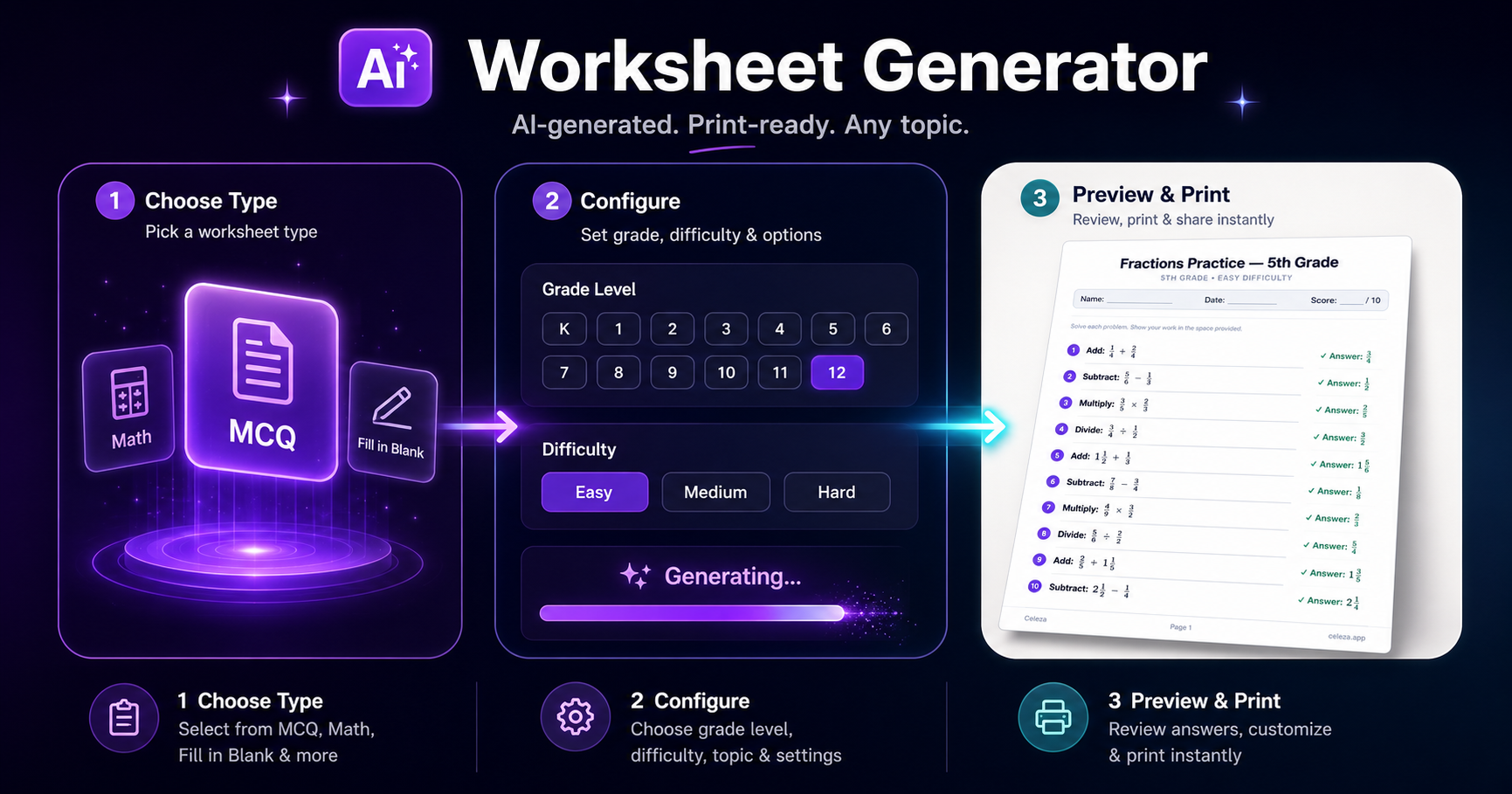

How Personalized Quiz AI Fixes Your Weak Topics Before Exam Day
A
Ashutosh Gupta
Founder, Pushlogics | Creator of Geleza
Share:

Advertisement
You probably already know re-reading your notes doesn't work. But here's how badly it fails: 91% of students still rely on passive re-reading as their primary study method, even though research consistently ranks it as the least effective technique (PubMed / CPTAL, 2026). The real problem isn't effort. It's that generic quizzes test what you already know. They don't find what's broken.
Personalized quiz AI changes that equation entirely. Instead of recycling a static question bank, it analyses your wrong answers, identifies the exact topics dragging your score down, and fires targeted questions at precisely those gaps. This post walks you through how that feedback loop works, who benefits most, and how to put it into practice today.
Advertisement
Key Takeaways
- 91% of students re-read notes, the single least effective study method (PubMed, 2026)
- Without active review, memory drops to just 27% retained after one day (Murre & Dros, PMC, 2015)
- AI-personalized learning produced 117% more participation and 3.3% higher exam scores (PMC, 2025)
- Spaced repetition delivers 80% recall vs 60% for cramming (Voovo / JEP, 2024)
- The fix: upload notes, quiz on weak areas, let AI schedule your next review automatically
For a broader look at what's changing in student study habits, see our guide to the best AI tools for students in 2026.
Why Do Generic Quizzes Fail to Improve Retention?
Retention drops to just 27% after a single day without active review (Murre & Dros, PMC, 2015). That number should alarm every student who studies hard the night before an exam. At 20 minutes after learning something new, you're already down to 44% retained. By six days out, that falls to 20.5%.

Generic quizzes don't fix this. They test the same questions in the same order, regardless of what you actually got wrong last time. You might breeze through ten questions on topics you've already mastered, then get a single confusing question on your real weak spot and move on. The quiz never noticed. It never flagged anything for follow-up.
There's also a subtler trap: the fluency illusion. When you re-read your notes or flip through flashcards you already know, the material feels familiar. Your brain registers that familiarity as understanding. But recognition is not retrieval. You can recognise a formula without being able to apply it under pressure. Quizzes built on static question banks reinforce this illusion because they keep asking questions you can already answer.
What you need is a system that detects your blind spots, not one that confirms what you've already learned.
Citation Capsule: Forgetting is not gradual, it's steep. Research by Murre and Dros (PMC, 2015) confirmed Hermann Ebbinghaus's original forgetting curve: without active review, memory retention falls from 44% at 20 minutes to just 27% at one day and 20.5% by six days. This is why passive study methods consistently fail before exams.
For a deeper look at the methods themselves, see 5 study techniques actually backed by science.
How Does Personalized Quiz AI Actually Work?
Adaptive AI identifies weak topics by analysing every wrong answer you give, then generates targeted questions on those specific areas until your performance actually improves. It's not just randomising a question bank. It's running a diagnostic loop in the background, adjusting difficulty and topic weighting after every response.
Here's how the feedback loop actually runs. You take a quiz. The AI logs every question you answered incorrectly, not just your final score. It maps those errors back to specific topics or concepts. In the next session, it increases the frequency and difficulty of questions on exactly those topics. When you start getting them right consistently, it scales back and flags a new weak area.
Most apps that call themselves "adaptive" are doing something much simpler: they shuffle a fixed question bank and call it personalised. Real adaptive AI needs to do three things simultaneously - track per-topic performance over time, adjust difficulty dynamically, and schedule reviews before forgetting kicks in. Static shuffle doesn't do any of these.
The research backs this up. Medical students using an AI-personalised learning platform showed 117% more classroom participation and achieved 3.3% higher exam scores (p=0.034) compared to control groups (PMC, 2025). That difference comes from the system knowing what each student doesn't know.
Citation Capsule: A 2025 controlled study published in PMC found that AI-personalised learning produced 117% more classroom participation and 3.3% higher exam scores among medical students (p=0.034) compared to standard instruction. The key mechanism was continuous weak-area detection and targeted question generation, not broader content coverage.
See our full breakdown of the best AI tools for students in 2026 to compare what each category of tool does well.
The PDF to AI to Quiz to Improvement Loop (Step by Step)
Students using AI-driven personalised learning logged 117% more classroom participation and achieved 3.3% higher exam scores than control groups (PMC, 2025). That result comes from a specific process. It isn't magic. It's a repeatable loop you can run with your own notes and PDFs, starting today.
Here are the six steps that make it work:
Step 1: Upload Your Notes, PDF, or Topic List
Start with whatever you already have. A scanned chapter from your NCERT textbook. A PDF of lecture slides. A list of JEE Physics topics you've been avoiding. The AI reads the content and builds a topic map from it. You don't need to categorise or format anything manually.
Step 2: AI Generates Mixed-Difficulty Questions on Your Weak Areas
The system doesn't give you ten easy questions to warm up. It mixes difficulty levels and targets the specific topics you declared as weak, or the ones your past quiz history flagged. You get questions that actually challenge your current knowledge gaps.
Step 3: Take the Quiz and Get Instant Explained Feedback
Every wrong answer comes with an explanation, not just the correct option highlighted. You learn why you were wrong. That explanation becomes part of the retrieval process itself, which strengthens memory far more than a simple "incorrect" notification.
Step 4: AI Flags Your Highest-Error Topics
After each session, the AI generates a weak topic report. It shows you which concepts caused the most errors, ranked by frequency. For a JEE aspirant preparing for Chemistry, this might surface "electrochemistry" and "chemical bonding" as priority areas for the next session.
Step 5: Next Session Targets Your Flagged Topics First
You don't choose what to study next. The AI loads harder questions on your weakest topics automatically. Correct answers gradually shift the difficulty back toward balanced coverage. This keeps every session productive even when you don't feel like strategising your revision.
Step 6: Spaced Repetition Schedules Your Next Review
The AI doesn't let a topic go quiet for weeks. It schedules your next review using spaced repetition intervals, timed to hit just before you'd forget the material. This directly counters the forgetting curve data: 44% retained at 20 minutes drops to 20.5% at six days without a scheduled review.
Citation Capsule: A 2025 study in the International Journal of Instruction found that students using an adaptive real-time quiz platform improved significantly over paper-based quizzes (p<0.001). The trial ran 100 high school students through a pre/post-test design and recorded higher engagement, faster response times, and better academic scores in the adaptive group (IJEK, 2025).

If your source material is a PDF, see how Geleza's PDF Chat turns any document into an interactive study session.
What Makes an AI Quiz "Personalized" vs. Just Random?
Spaced repetition users hit 80% recall accuracy compared to just 60% for cramming (Voovo / JEP, 2024). That 20-percentage-point gap doesn't come from studying more hours. It comes from studying at the right time, on the right topics, at the right difficulty. That's what genuine personalisation delivers.
Three pillars separate real personalised quiz AI from a reshuffled question bank:
Topic weighting assigns more questions to concepts where your error rate is high. If you're scoring 90% on Newton's Laws but 40% on Rotational Dynamics, a truly personalised system sends you five rotational questions for every one Newtonian. A random quiz sends you the same mix regardless.
Difficulty scaling adjusts question complexity based on your current performance level on each topic. Getting three consecutive questions right? The next one gets harder. Struggling? The system backs off to foundational questions and rebuilds your understanding from a lower level.
Timing intervals are the most underrated piece. The AI tracks when you last reviewed each topic and schedules the next review at the optimal forgetting-curve interval. This is what turns a quiz tool into a genuine study system.
The evidence beyond individual studies is equally clear. A meta-analysis across 118 studies found that formative assessment, which includes regular low-stakes quizzing, produces a mean effect size of g=0.25 (Tandfonline, 2024). Even modest increases in quiz frequency produce measurable learning gains. The effect compounds when those quizzes are targeted at weak areas.
Citation Capsule: A 2024 meta-analysis spanning 118 studies (Tandfonline) found formative assessment produces a mean effect size of g=0.25 on learning outcomes. When combined with spaced repetition, which delivers 80% recall accuracy versus 60% for cramming (JEP via Voovo, 2024), personalised quizzing becomes the highest-impact study method available to students.
For a full breakdown of spaced repetition and the other evidence-based methods that work alongside it, read 5 study techniques actually backed by science.
Who Benefits Most From Personalized Quiz AI?
92% of higher education students now use generative AI, up sharply from 66% in 2024 (HEPI, 2025). But most students are using AI passively: asking it to summarise their notes, generating essay outlines, asking definitions. That's passive consumption with a modern wrapper. Personalized quizzing is the active-use shift that actually moves scores.
Advertisement
Three student profiles see the biggest impact from personalised quiz AI, and their needs are genuinely different.
College Students Juggling Multiple Subjects
A student preparing for semester finals typically has five or more subjects in rotation. The challenge isn't understanding the material. It's knowing which chapters need emergency revision in the final week. Personalised quiz AI runs that triage automatically. It tells you which topics are at highest risk of blanking out on exam day, so you spend revision hours where they count most.
JEE, NEET, and UPSC Aspirants
These exams cover two to three years of syllabus. Every revision hour matters at a different level of stakes. A JEE aspirant who spends three hours on a chapter they've already mastered has wasted time they can't recover. Personalised quiz AI acts as a weak-chapter triage system, pointing study hours toward the specific Physics, Chemistry, or Biology concepts where performance is actually below threshold.
Self-Learners Working From PDFs and YouTube
Not every learner has a structured classroom. Many UPSC aspirants, working professionals upgrading skills, and self-taught coders learn from a mix of YouTube lectures, downloaded PDFs, and online articles. Personalised quiz AI converts that unstructured input into structured, quizzable content with tracked performance over time.

For more on building an AI-assisted exam prep workflow, see our guide to the best AI homework helper tools for students.
How Can You Generate a Personalized Quiz From Your Notes With Geleza?
AI tutoring produces effect sizes of 0.73 to 1.3 standard deviations, which is the equivalent of moving a student from the 50th to the 73rd percentile (Engageli, 2026). AI-enhanced active learning also shows 54% higher test scores versus traditional methods (Engageli, 2026). These gains are achievable with tools available right now.
Here's the concrete workflow inside Geleza's quiz generator:
Go to the Quiz Generator. Head to Geleza's Quiz Generator from your dashboard. No setup required.
Upload a PDF or type your topic. Paste a chapter name, upload a PDF of your lecture notes, or type the specific topics you want to be tested on. Geleza reads your content and builds questions from it directly.
Select subject area and difficulty level. Choose from beginner, intermediate, or advanced. Select your subject so the AI weights question formats appropriately (numericals for Physics, conceptual MCQs for History, definition questions for Biology).
Get a personalized quiz in under 30 seconds. The quiz loads immediately. Questions target the weak areas you've identified or flagged from previous sessions.
Review your weak topic report after each session. After submitting, Geleza shows you exactly which topics caused errors and how your performance compares to your previous sessions on the same material.
Ready to stop guessing which topics to revise? Geleza's AI quiz generator builds a personalized quiz from your notes, PDFs, or any topic - and tracks your weak areas so every session hits exactly where you need it. Start your free quiz on Geleza →
Explore Geleza's full AI study toolkit — math solver, PDF chat, YouTube summarizer, writing tools, and more.
Frequently Asked Questions
Is personalized quiz AI better than Anki or Quizlet for exam prep?
For most students, yes, especially at the start of a new topic. Anki and Quizlet require you to create your own cards, which takes time and assumes you already know what to review. Personalised quiz AI generates questions from your notes automatically and identifies gaps you didn't know existed. A 2025 adaptive quiz study found statistically significant improvement over paper-based quizzes (p<0.001) (IJIET, 2025). The two tools work well together: use AI quizzing for gap detection, then Anki for long-term spaced repetition on confirmed weak cards.
Can I generate a quiz directly from a PDF or lecture notes?
Yes. Tools like Geleza's quiz generator accept PDFs, typed topics, and pasted text directly. The AI reads the content, maps the key concepts, and generates mixed-difficulty questions targeting your stated weak areas. This is particularly useful for NEET aspirants working through NCERT chapters or UPSC candidates reviewing dense government reports. You don't need to reformat anything before uploading.
Does personalized quiz AI work for JEE, NEET, or UPSC preparation?
It works especially well for high-stakes exams with large syllabi. JEE Advanced covers two to three years of Physics, Chemistry, and Mathematics. UPSC's General Studies spans current affairs, history, economics, and science. Personalised quiz AI helps you prioritise which topics need the most revision time, rather than covering the entire syllabus uniformly. AI tutoring effect sizes of 0.73 to 1.3 standard deviations (Engageli, 2026) suggest meaningful performance gains for any exam requiring targeted recall.
How many quiz questions should I practice daily for best retention?
Research doesn't prescribe a fixed number, but consistency matters more than volume. The spaced repetition principle suggests shorter, more frequent sessions outperform long marathon sittings. A 2024 meta-analysis of 118 studies found that even low-frequency formative assessment produces measurable gains (g=0.25) (Tandfonline, 2024). Most students see good results with 20 to 30 targeted questions per session, five to six days a week, timed to their AI-scheduled review intervals rather than cramming in bulk the night before.
Conclusion
The forgetting curve is not a metaphor. Memory falls to 27% retained after just one day without active review (Murre & Dros, PMC, 2015). Passive re-reading keeps 91% of students running in place, convinced they're studying while their recall quietly erodes. Personalised quiz AI breaks that cycle by replacing the re-read loop with a tighter one: upload, quiz, detect gaps, target those gaps, repeat before forgetting sets in.
The step-by-step loop in this post works whether you're a college student facing semester finals, a JEE or NEET aspirant triaging a three-year syllabus, or a self-learner converting YouTube videos into structured knowledge. The mechanics are the same. The AI does the diagnostic work. Your job is to show up and take the quiz.
Start with one PDF, one chapter, or one topic list. Let the results tell you where to go next.
To understand the bigger shift behind all of this, read how AI is transforming student learning.
Advertisement
Found this helpful?
Share it with your classmates.
Share: