

Cursive Alphabet Practice Sheets
Copy the dark model · trace the dotted letters · then write on your ownFind more free printable worksheets at geleza.app/worksheets · © 2026 Geleza · All rights reserved
About this worksheet
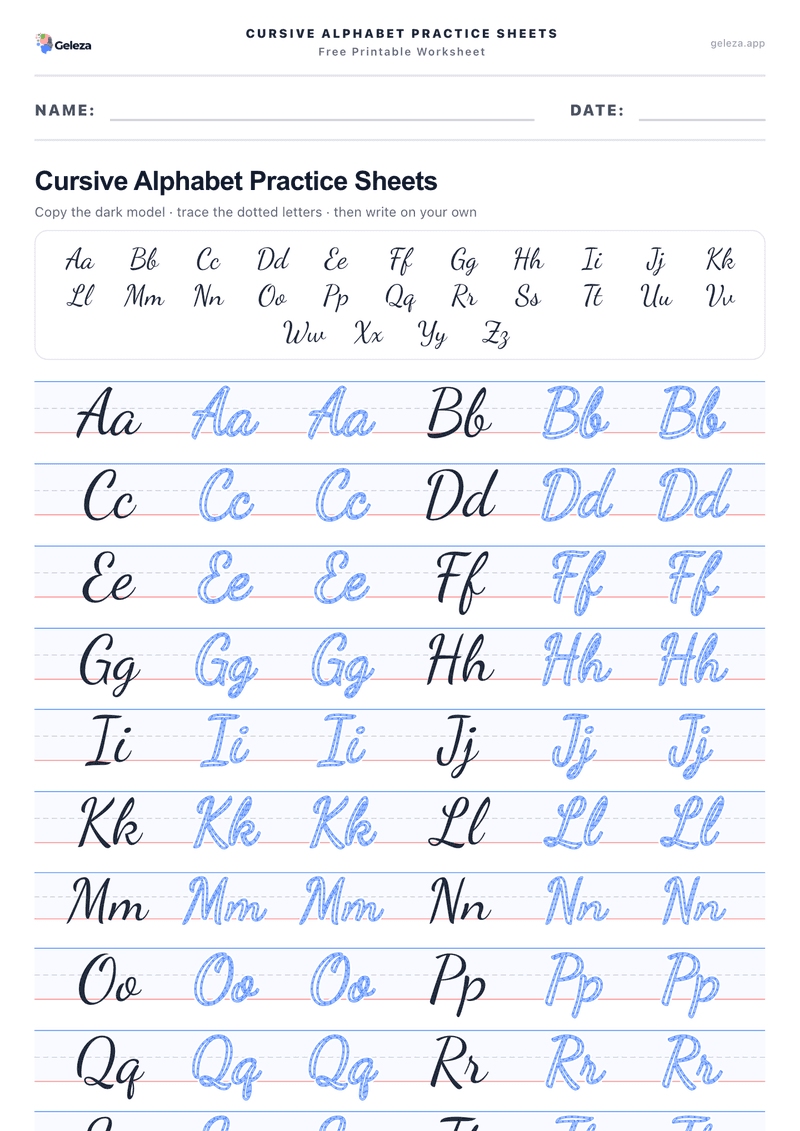
The cursive alphabet sheet covers all 26 letters on two pages. It opens with a reference chart of every capital and lowercase letter, then gives each letter pair a model to copy and dotted letters to trace. Use it as a weekly review once children have learned the letters one at a time, or as a quick check of which letters still need practice.
Print it free on A4 or US Letter paper, or pick Save as PDF in the print window to keep a copy. Want your own words instead? The cursive worksheet generator turns any spelling list or sentence into tracing rows, and the 4-week daily cursive practice plan shows what to practise each day.
How to use these cursive alphabet practice sheets
Each row starts with a dark model of the letter pair, for example Aa, followed by two dotted copies. Look at the model first and notice where the letter starts, where it goes up and where it finishes. Then trace the dotted copies slowly, keeping the pencil on the paper until the letter is finished.
Do not try to finish both pages in one sitting. Five or six letters a day, about 10 to 15 minutes, works better than a long session. Children get tired, the letters get sloppy, and they end up practising mistakes.
Learn the lowercase letters in groups
Lowercase cursive letters fall into a few families that start with the same stroke. Teaching one family at a time means each new letter reuses a movement the child already knows:
Upstroke letters: i, t, u, w, r, s, p and j start with a short slanted stroke up from the baseline. The c family: a, c, d, g, o and q all start with the same curve as the letter c. Loop letters: e, l, h, k, b and f use a loop that goes up to the top line and comes back down. Hump letters: n, m, v, x, y and z start with a small hump over the top.
When a whole family is easy, move on to the next one. The capital letters come last, because they are only used at the start of names and sentences.
Watch the three guide lines
Every row has a blue top line, a dashed midline and a red baseline. All letters sit on the red baseline. Small letters such as a, c, e, o and u stop at the dashed midline. Tall letters such as b, d, h, k, l and t reach up towards the top line. Letters with tails, such as g, j, p, q, y and z, drop below the baseline.
If a child's letters are all different heights, point to the midline and ask which letters are allowed to go above it. Height is the first thing that makes cursive look neat.
Common mistakes to look out for
Lifting the pencil in the middle of a letter: cursive letters are written in one movement, so the pencil only lifts at the end of the word or to dot an i or cross a t. Loops that are too big or too flat: an e and an l are the same shape, the l is just taller. Letters that lean in different directions: a slight, even slant to the right looks neater than letters leaning both ways. Gripping too hard: a relaxed grip lets the hand move smoothly from letter to letter.
After the alphabet: join letters into words
Once a child can write every letter on its own, move on to joining letters. The cursive letter worksheets A to Z each finish with three short words to trace, and the sentences worksheet practises whole lines. For a day-by-day schedule, follow the 4-week daily cursive practice plan, and use the free cursive worksheet generator to make sheets from your child's own spelling words.